
1. Forums
  2. Discord
  3. About Mapcore
  4. Patreon Supporters
  • Login
  • Register
  • Search
This Thread
  • Everywhere
  • This Thread
  • This Forum
  • Articles
  • Pages
  • Forum
  • More Options
  1. Mapcore
  2. Discussions
  3. Creative Chat

How to break in the games industry - an insiders' guide

  • Furyo
  • August 23, 2009 at 3:54 AM
  • yellowoats
    • September 29, 2015 at 12:57 PM
    • #221

    The first couple of pages of this thread were awesome. I work in a parallel industry (tabletop game development) but have a software engineering background (have contributed to DIY game dev projects). I'd say some of these topics really apply to any creative work - like making your development unique and able to stand-out.

    I haven't gone' through the entire thread, but I would add, make sure you surround yourself with people who are better at dev than you are in certain areas. It will push you to develop a much better asset than you would otherwise. But most people know that - everyone I know who is in game dev has a host of mentors. Awesome thread.

  • Sirlock
    • October 12, 2015 at 6:37 PM
    • #222

    I have been interested in getting into game development for years but I wound up going straight to work (I have a solid job for only a high school education.). Recently I really wanted to go back to school to try to get a bachelors in game design and was more or less curious how prevalent employers in the industry look at what school you do graduate from? I ask because it would be a semi long term process (as all extra-educational school is....) because I would primarily be doing it all as online courses due to working a really good full time job (I just see it as a placeholder job till I find something I am passionate about), but working overnight. So I figured I would try and get myself into the best position out of school as possible. I understand that the school you go to isn't always everything a lot of it is usually what you can offer that differs from everyone else, or rather makes you unique. (Did I just answer my own question????) Input would be awesome!

  • RaVaGe
    • October 12, 2015 at 9:31 PM
    • #223

    Keep your job, fuck the school, and make a lotta stuff while you're at home, oh, forget about your social life too, if you don't have one, then you're perfect stay how you are.

    More seriously, losing your job for going back to school is the worst move you can do, keep your income and work hard on your free time, get in the feedback loop and iterate your work, then move on. There's plenty of tutorials on the internet, you are actually in one of the best level design forum with a lot of great active talents, you don't need much more, imo you will waste a lot of time if you go to school.


    Just my 2 cents, i'm not into the industry so take my advice with a pinch of salt, but yeah, just make stuff man, you don't need someone behind you to tell you what to do next.

  • Guest
    • October 15, 2015 at 8:52 PM
    • #224

    I've been reading through this thread and found a ton of great advice. I just had a couple of questions for some of you who work in the industry. So I'm kind of using my free time while in school to build a portfolio (Level Design) so that when I graduate I can start applying and hopefully get something in the games industry.

    Let's say you apply as a Level Designer for a company and you have no experience with how their engine/editor works (and they don't have tools out there for you to learn). What then?

    I play games and unless I've actually used the game's mod tools/level editor I honestly have no idea how they are structured/how they are made. Most of my experience comes from Skyrim's Creation Engine and Source Engine. I feel like these engines are a little niche in terms of how their levels are built (because they are older engines), but I honestly have no clue. Would skill/knowledge in slightly older engines like Source/Creation transfer over easily to more modern engines? Should I use my time to work in more modern toolkits?

    If you work in Level Design, what tools/programs are you using to create your levels? How would you describe your day to day tasks?

    Basically I'm worried about the transfer process between modding/mapping to working in a professional environment. Would you say that creating mods/maps prepare you for a professional industry job, or is there something more that I'm missing out on? I feel like I have alot of gaps to fill. Thanks for any information and sorry if some of this is poorly worded.

  • TheOnlyDoubleF
    • October 15, 2015 at 9:58 PM
    • #225
    Quote from nikkoship

    I've been reading through this thread and found a ton of great advice. I just had a couple of questions for some of you who work in the industry. So I'm kind of using my free time while in school to build a portfolio (Level Design) so that when I graduate I can start applying and hopefully get something in the games industry.

    Let's say you apply as a Level Designer for a company and you have no experience with how their engine/editor works (and they don't have tools out there for you to learn). What then?

    I play games and unless I've actually used the game's mod tools/level editor I honestly have no idea how they are structured/how they are made. Most of my experience comes from Skyrim's Creation Engine and Source Engine. I feel like these engines are a little niche in terms of how their levels are built (because they are older engines), but I honestly have no clue. Would skill/knowledge in slightly older engines like Source/Creation transfer over easily to more modern engines? Should I use my time to work in more modern toolkits?

    If you work in Level Design, what tools/programs are you using to create your levels? How would you describe your day to day tasks?

    Basically I'm worried about the transfer process between modding/mapping to working in a professional environment. Would you say that creating mods/maps prepare you for a professional industry job, or is there something more that I'm missing out on? I feel like I have alot of gaps to fill. Thanks for any information and sorry if some of this is poorly worded.

    Modding and mapping experiences are still strong arguments in a portfolio for some companies. It proves that you want some 'cause you took time to create this and learned by yourself, you're autonomous and you've got your workflow. Finishing a project is already better than most of people. I've seen a bunch of dudes in my school applying even without any portfolio to companies like DICE or Ubisoft just because they thought the diploma would give them a job. It's sad but true.

    Concerning editors, Skyrim's editor is indeed very special but it's a requierement if you want to work at Bethesda for example. Source is good but I think it's very common to see this in people's resume. The important point is what you did with it. Is it just building? importing assets? lighting? Level design + playtest? scripting? This defines what makes you interesting in the first place; Key Words; because HR pass very quickly on resumes/portfolio. So I don't think Source is niche but I personnaly can't say how it is important in a profile. Many principles are still the same in modern engines and i'm pretty sure that you could get into one if you made it through Source. The little I know from Source has been very helpfull to me to understand other tools and to learn one way of level creation. Obviously, beeing able to use modern tools like Unreal Engine 4 or Unity is a requirement but i may be wrong. Almost everyone works with these and home-made engine are very close. So if you know one of them, it would be much more easier to move to a company who use another modern engine.

    You should read this : https://migrationtest.mapcore.org/articles/inter…s-industry-r67/
    Tasks and workflow depend on the company, the project and the size of the team so it's difficult to give the right proper example. Some use narration, game design, art direction, a lot of things can modify the way you work and what the studio needs from you. Older could probably talk a bit more about this than me.

    To me, the most difficult things may not be about tools or workflow, but about people. It may not always be easy to join a built team. You have to learn about people, how they think, how they work, how you should interact with them etc. The is the side where you learn about the team and which role you should take in this group. It is also a real work on yourself. If you are introverted it can be really hard for you and for the team as much as if you are extroverted (exhausting for the team (can also be refreshing)). It really depends on the people you'll work on but it's really something to concider to me. After explaining my skills in an interview or something, I always try to put a bit the human side of the work on the table 'cause you're not joining a studio to make your level alone.

  • Corwin
    • October 17, 2015 at 9:19 AM
    • #226

    In my experience, what engine you have experience with only gives you a small boost when it comes to being hired: it's always a plus if your future colleagues don't have to train you and you can jump right in. But it is more important to see relevant experience and quality level design in someone's portfolio, no matter what they built it with.

    When I mean quality LD, it's a lot of different things combined together, like showing you understand what you're doing and why, showing you can stick to the end and finish something, balance it, that you have an eye for detail, that you know how to lead a player, that the spaces you build are well sized, that you have good scripting experience, that you can create something original that stands out, that you are able to present all those facets of your levels in a straightforward manner through your portfolio and interviews... (a lot of people I interviewed through the years may have been good but were bad at showing that.) And of course there's the actual professional experience which reassures potential employers that you've gone through development and all of its intricaties and can work as a team, deliver on time, etc.

    Without the professional experience, you have to do a better job at showing you're a good LD through the content of your portfolio and through LD tests that companies give you to assess your skills (and usually start as intern/junior because it's still a bit of a bet for employers, and in some cases because they know you're desperate and they can offer you a shit pay while knowing you'll give all you've got). With relevant pro experience, you're already half-way there and usually the interviews are where the selection happens. When I say valid experience, it's stuff the studio you apply at can use, for instance if you worked on racing games for a while and applied at a FPS-centric company, they may have some reservations about you and have to dig through your personal projects or really drill you at interviews to determine if you'd be worth their investment. That doesn't mean your racing game experience is bad, it will have taught you valuable skills and you'll have gotten through a game's dev process at least once; just that you may have a tougher time convincing employers that you're a good fit if you have no experience in the kind of games they do (rather than with the exact engine they use). Also, completed personal projects are always a plus in any case, whether you have pro experience or not.

  • Guest
    • October 17, 2015 at 9:48 PM
    • #227

    Thanks for taking the time to write these responses, guys - helps alot. I guess I'm just a little worried to sticking with one engine, and I feel a little bit of pressure to branch out to more modern toolkits.

  • Corwin
    • October 18, 2015 at 9:06 AM
    • #228

    It would probably be a good idea to get at least one thing done with a modern engine, because there are some staples of modern engines that potential employers will wonder if you can quickly jump to. For instance visual scripting would be one of those things: if you only ever used old school scripting engines, people may be concerned they have to 'teach you' visual scripting and favor someone who does have that experience. It's probably worth grabbing Unreal Engine at one point or another in your journey to get up to date with that. But like I said, shit content in a portfolio isn't saved by modern engines, whereas old school but great content + selling yourself at interviews can work.

    However, the opposite phenomenon can happen, where focusing on what you really like and not what the current demand at employers is ends up paying off. For instance building cool content with Bethesda or Valve's toolkits can lead to employment at such companies. It's a choice you have to make, whether to follow what you love and hope it will lead to great things, or mix it up with experience that meets the popular demand to get some doors open and vary your options in the future.

    Personally, I started doing what I loved, not thinking too much about future employment, then over the years moved on to doing stuff that could get me hired more easily (more known engines, smaller/more frequent projects, higher profile games...) but that's not necessarily the best course for everyone.

  • marnamai
    • December 5, 2015 at 12:50 AM
    • #229

    Man, I have been applying twice a week for the last couple months and it can be really demotivating.
    I have had responses from a couple companies, but none positive so far.
    It basically all comes back as " Thank you for your interest, but we have other candidates who better fit our needs. We'll keep your resume on file, ect ..."

    On a couple occasions I have tried to ask for feedback from the recruiters, so I could improve myself, but I haven't heard back from any of them.

    I think my portfolio is pretty solid, but I would appreciate it if you guys could take a look and give me your brutally honest opinions on what to improve.
    http://marnamai.interlopers.net/

  • Pampers
    • December 5, 2015 at 1:22 AM
    • #230

    Remove this:

    Quote

    Professional experience

    • -none- hire me! :P
  • tomm
    • December 5, 2015 at 1:34 AM
    • #231

    I'd say get rid of the "3D Artist" section, it's not very interesting + having a focused portfolio is always better(imo)

    and I assume you wanna do level design anyway.

  • marnamai
    • December 8, 2015 at 5:01 PM
    • #232
    Quote from tomm

    I'd say get rid of the "3D Artist" section, it's not very interesting + having a focused portfolio is always better(imo)

    and I assume you wanna do level design anyway.

    A lot of companies looking for leveldesigner state that they want someone with 3d experience, I find it hard to justify saying I have 3d experience without showing examples of it.

  • mjens
    • December 9, 2015 at 6:39 AM
    • #233

    Yes, focusing portfolio is not a good idea at all. If you can make a 3D art, show it. If you can make nice pictures, make sure to put that somewhere in your folio. When I'm checking someone's website I want to learn as much as I can to know if you'll fit into the team. Often it's not experience and your levels but your "kind of being" - if you're easy going, finishing projects, willing to learn and accepting feedback then you're on a good way.

    I mean, it depends actually on the employer. Some companies, or I would say, serious leaders will take your different experiences and skills as an advantage (photography will prove your art and composition skills/understanding; adding your steam account link will allow us to take a look on your gamers you play and if we want an active player then this is how it can be judged on the first time - before the call or studio interview), lazy or uninformed bosses can be like "Get rid of it, you're LD and it stays like that". As you can see, it comes to the responsibilities. If someone want to make you a cog in the huge machine, they'll check your most important and main skill. If someone wants to build a team of experts that will work smooth and independent then probably they'll be looking for people with leadership skills and positive attitude, knowing many different aspects of working in the industry etc. It's hard to find that kind of people and I think that only huge companies can effort to hire such guy when they already understood their value (the candidates of course, not employers ;)). So when making a portfolio, create an image of a great employee, not a cog in the machine. It's not like you should be a one-man-army kind of designer but the openness for new experiences and skills should be somehow presented. It shows how you're wired, it's a part of your attitude.

    In short, imagine that you start with 100 points and you're getting negative points for anything that you don't need for this current dude you're applying to. One can leave you with 5 points left because you have crap that he's not interested in (which can be really wrong idea for hiring) or someone can give you 85 points because of some minor stuff and he actually liked it and he found what he was looking for.

  • Corwin
    • December 9, 2015 at 9:11 PM
    • #234

    I'm participating in a lot of interviews for new hires at the moment so I think I can comment on this: in my experience, having extra stuff on a portfolio is never a bad thing, it's more about how you sell yourself as being primarily focused on.

    For instance, we sometimes get resumes of people who've been like: level designer, VFX Artist, Environment Artist, Game Designer... and then Level Designer only at his/her current position, and it's really hard to judge that sort of resume because you don't really get why the guy jumped around so much between different roles, how he could have managed to develop his actual level design skills by doing so many varied tasks, how much time he worked under each different title, etc. and you have to send extra questions or have a phone/skype interview to dig into those question marks (which takes time and some preparation so sometimes we can end up favoritizing another candidate with a more straightforward career path). But, more often than not, it's just that the person wanted to mention every little thing she's contributed to on each project: he was actually hired for and mainly focusing on level design, but because he had the knowledge and the company was small, he also did the extra vfx art and environment art etc. Which of course is totally fine, it would be stupid to penalize a candidate that's a good LD for having extra skills (commonly LD teams end up having a panel of LDs from different backgrounds/interests, like one is an architect, one is a historian, one is a photograph, one was an artist before, etc. and it's only better for it). It's just that it doesn't really come across like that from glancing at his resume/portfolio and may mean, in cases of many applicants or lazy/busy employees, that you get ignored, forgotten, postponed till after another candidate has had his interview, etc.

    So my advice would be to always tailor your resume and portfolio to the job you're fishing for. If you want a LD position, make it super clear you are mostly focused on LD and all the cool stuff you built and know etc. and add the extra skills as secondary instead of woving them all together into a mess that's hard to get an impression of. For instance, I'm usually an advocate for 'all on one page' portfolios (although it's not my role to tell you how to present your work etc.) and in that sort of layout I'd put the LD stuff at the top and the art, photography, essays, reviews, whatever related activity at the bottom of the page in what you consider the order of interest to a potential employer.

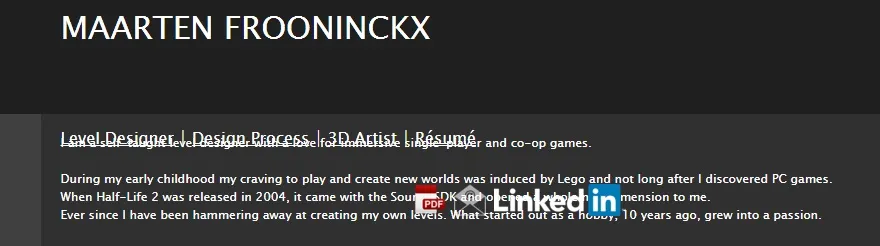
    In the particular case of your current portfolio, it would be slight touches such as renaming 3D Artist to something more 'humble' maybe, that shows that you don't necessarily consider yourself a full fledged 3d artist but have dabbed into that field and gain some very valid experience out of it; or increasing the font size of LD page links and decreasing the one for extra activities, or really fleshing out the LD page with lots of content and info so it's clear that this is your primary skillset, etc. In any case, I think you should do a new thread to get feedback on your portfolio in general, as I think there's some simple but efficient things you can do to make it a bit more 'professional-like' (fixing a few things like overlapping text (happens to me on chrome, see picture attached), filling up your process page or getting rid of it so it doesn't seem WIP, and adding a bit more descriptions/detail of your LD projects for instance)

    Extra note on portfolios though: from my experience, I cared a lot about how I would lay out my portfolio when I was looking for a job, but when I look at a candidate's portfolio, I rarely really pay attention to the layout of it or its aspect and go fishing for the content. I often only have a few minutes to dedicate to an application before I go: yes, let's do an phone interview or no, we have better candidates down the pipe or this one is just not what we're looking for. So portfolios in the end (again, in my experience) are really a case of 'I will only care about the aspect/layout if it really sucks'. I would prefer a Word document with pictures and descriptions in it that really manage to convey the candidate's strong points, experience (pro or not), specific skillset (MP, SP, MMO, Mobile, ...) etc. than a fancy portfolio with only nice pictures and nothing for me to dig my teeth in.

    Anyway, it's always a bit weird to advertize stuff like that because it can just lead to you being disappointed/or us put in an awkward position, but in any case feel free to apply as an LD at CIG Frankfurt if Star Citizen would interest you, we don't have a junior LD position open at the moment but in general we consider all applicants and try to dig deeper than what's on the resume to find potential diamonds in the rough, so if you're confident about your LD skills but have trouble getting employers to even give you a chance to convince them of your abilities, it MIGHT be different here (no promises of course, I don't make the calls, and I can be fairly ruthless during interviews). And if it only goes as far as a skype interview, that's always good experience to take, might give you the edge on a future interview.

  • blackdog
    • December 11, 2015 at 9:41 PM
    • #235

    Very interesting post @Corwin, thanks for sharing. I just got a new hosting yesterday and I'm gonna put my own portfolio back up.

    I've been wondering recently if it would be positive to make a portfolio page tailored to the employer one is applying at. Like say highlighting stuff made in CryEngine if applying at CryTek when one has multiple engines skills. Or just in general find a way to tailor the page to a company, like you do with cover letter.

    And speaking of letters, can it be that one is dismissed straight from the letter of application, and the website is not even looked at? I dunno, just had a very quick look at marnamai's portfolio, but gave me the impression of someone who mainly designs maps, the comments about 3D surprised me a bit.

  • Corwin
    • December 12, 2015 at 8:17 AM
    • #236
    Quote from blackdog

    Very interesting post @Corwin, thanks for sharing. I just got a new hosting yesterday and I'm gonna put my own portfolio back up.

    I've been wondering recently if it would be positive to make a portfolio page tailored to the employer one is applying at. Like say highlighting stuff made in CryEngine if applying at CryTek when one has multiple engines skills. Or just in general find a way to tailor the page to a company, like you do with cover letter.

    And speaking of letters, can it be that one is dismissed straight from the letter of application, and the website is not even looked at? I dunno, just had a very quick look at marnamai's portfolio, but gave me the impression of someone who mainly designs maps, the comments about 3D surprised me a bit.

    I personally wouldn't adjust the portfolio for a single company, just for the fact that you may be applying a different ones at the same time. It's hard to know exactly what the company is going to be interested in based on their ongoing projects etc. so better mention everything in a way that's easy to browse through and get the gist of it (experience with what tools, strong points, extra skills...) and let them cherry-pick what suits them (IMO)

    I wasn't really saying that marnamai's portfolio is necessarily bad in the way he shows his 3d art skills, my post was more of a general point about how to sell yourself, and then an example of how that could apply to his portfolio. For instance I would say it'd be more critical (IMO) to add more info about the projects he's worked on than to restructure the pages he has.

    I don't know about cases where employers stop at the cover letter. In my experience, who cares about cover letters? They all sound almost exactly the same, and even when the candidate gets a little original with it, it doesn't stand on its own anyway and can just maybe give you an idea of the personality of the candidate. It could go no further than the resume I guess if the experience on it is way too little compared to the needs for that position, but personally I always click the portfolio link (or LinkedIIn if there's no portfolio) out of curiosity and for the sake of being thorough.

  • TheOnlyDoubleF
    • December 12, 2015 at 9:19 AM
    • #237

    @Corwin @seir But to get a junior position, do you have to know exactly which way to go ? Let me explain. I've worked on several small projects as game designer or level designer, probably something like 45/55. Just like I did at Eden Games where i've been 4 months level designer and 4 months game designer. Now on school projects, I've also often been the project manager 'cause I've obtained school mates' respect.

    So, I love game design, I love level design, I like managing a small team, I love the technical side of a project. I don't have any preferences right now, I love all of it. SInce I can get a technical job, it would be fine to me. What should I do? Should I apply to both game design and level design positions? I don't want to keep working in small teams, I want to be at Epic, Ubisoft, Avalanche, Arkane, Wild, Playground, Techland and others. What does the industry need right now?

  • Corwin
    • December 12, 2015 at 3:12 PM
    • #238

    I don't pretend to have the all the answers, but in my opinion you need to figure out what you want to apply for first. That's probably quite hard to do if you like all those things equally, but it's necessary. If I imagine someone working at Epic or another one of those companies you listed and receiving 2 applications from the same person, one for junior game designer, the other for junior level designer, I would expect them to be a little put off by the fact that you don't seem to know what you want. Those can be vastly different jobs and sets of responsibilities depending on the company.

    Of course, even if you 'choose wrong' and realize working as a GD or manager or LD is not fulfilling, there is always room for growth/change at most companies: once you know the team and they think of you as a person/colleague, not a name on a resume. Even bringing up the fact that you don't know whether you should apply as a GD or a LD at an interview can be valid, because you've established that human contact and can explain your situation, and interviewers can sympathise with you. I think it's that first step where they don't know anything about you and you must make a good enough impression to move on to the next steps of the recruiting process that it's going to be hard to cross if you don't know what you want.

    Could work if you have contacts already at a company though. This may even be a case of you visiting the office and spending some time with both GDs and LDs to get a gut check on what you think would suit you the most, but again that assumes you have this human contact with someone at that company.

    Sorry that there's no formula to getting hired, it's a lot of luck, a lot based on who you know too. Beyond that, it's pretty much common sense, and trying to put yourself in the shoes of the recruiter and seeing how you come across as a candidate.

  • marnamai
    • December 20, 2015 at 1:22 PM
    • #239
    Quote from Corwin

    Does this still happen, I 've tested it both on Chrome and Edge, works fine for me?

  • Corwin
    • December 21, 2015 at 10:44 AM
    • #240
    Quote from marnamai

    Does this still happen, I 've tested it both on Chrome and Edge, works fine for me?

    Nope, seems fine now, weird

Participate now!

Don’t have an account yet? Register yourself now and be a part of our community!

Register Yourself Login
Discord

The Mapcore Discord is our lively IRC channel of the 2000s reborn. Chat about level design, gaming, and more.

Latest Posts

  1. Why is data science needed

    shilpa
    July 17, 2026 at 12:39 PM
  2. Any of the old guard still around? D:

    Warby
    July 12, 2026 at 8:23 PM
  3. About our archived forums

    Thrik
    June 30, 2026 at 2:12 PM
  4. Mapcore Discord

    mason_fan123
    June 24, 2026 at 8:52 PM
  5. [CS2] Valley

    Serialmapper
    June 22, 2026 at 11:56 AM
  6. Free Music / SFX Resource - Over 2500 Tracks

    Eric Matyas
    June 18, 2026 at 12:32 PM
  7. Pango [WIP]

    Elowen
    June 11, 2026 at 10:13 AM
  8. [CS2] Dvina

    Jeremy Rivera
    June 11, 2026 at 10:03 AM
  9. Bridges 2.0 by NEXSIDE, MAP SHOWCASE. ( Steam Workshop )

    MrTrane18
    June 1, 2026 at 7:46 PM
  10. Classic Maps Reborn For CS2

    SillySpaceCat
    May 31, 2026 at 10:33 PM
  1. Privacy Policy
  2. Contact
Powered by WoltLab Suite™