
1. Forums
  2. Discord
  3. About Mapcore
  4. Patreon Supporters
  • Login
  • Register
  • Search
Everywhere
  • Everywhere
  • Articles
  • Pages
  • Forum
  • More Options
  1. Mapcore
  2. Members
  3. Corwin

Posts by Corwin

  • Epic Games & MapCore's Unreal Tournament Level Design Contest Discussion

    • Corwin
    • April 8, 2016 at 9:09 PM

    Holy crap, even my main PC at home can't run the editor properly, it's not a beast but I thought it would be fine since it runs the CryEngine editor alright. I think I might have to pass on the contest, opening the editor takes 3 minutes and dragging in a textured mesh from Chill froze the editor for 5 minutes... I'm probably lacking in the memory and HDD department :(

  • Push & Pull - The art of guiding players through an environment

    • Corwin
    • March 22, 2016 at 2:55 PM

    I'm afraid there isn't a compilation of all the parts into one document, you'd have to print each part individually and the pictures may be a pain (maybe disable them).

  • Push & Pull - The art of guiding players through an environment

    • Corwin
    • March 18, 2016 at 4:46 PM

    Thanks guys! /emoticons/[email protected] 2x" title=":)" width="15">

  • Clement Melendez - Level Designer

    • Corwin
    • March 16, 2016 at 10:00 PM

    I grew up tired of my old portfolio and did a complete overhaul of my portfolio and converted it to wordpress to add articles and shit more easily/with better format and less manually editing html files.

    http://www.clement-melendez.com/portfolio/

    I know there are small issues on certain phones with the format, I'll look into that when I have access to a smartphone.

  • Push & Pull - The art of guiding players through an environment

    • Corwin
    • March 16, 2016 at 9:56 PM

    Hey all,

    Because my busy life doesn't allow much time for side projects and thus doesn't satisfy the urge of doing something constructive, I wrote a multi-parts article about guiding players through environments (a subject that fascinates me greatly.)

    Push & Pull - The art of guiding players through an environment

    1. Introduction 2. Facilitate mental mapping 3. Influence via composition 4. Lure with affordance 5. Drive with goals & narrative 6. Communicate through a language 7. Direct with restrictions & cameras 8. Show with UI elements & cut-scenes 9. Conclusion I intend to tweak and improve the article if needed so I'd be very interested to hear your thoughts, criticism and feedback!

    Hope you like it!

  • Overwatch

    • Corwin
    • March 10, 2016 at 1:32 PM

    This game is superb, I haven't been hooked on a MP game for many many years and this did it in a couple playsessions. It's addictive, but the right kind, not the skinner-box/titillating-the-right-parts-of-your-brain-to-manipulate-you addictive, it's just freaking good.

    Also you know your art direction is awesome when you barely notice the difference between Ultra to Medium/Low, it doesn't impact the aesthetics of the game much at all

  • What's going on with your life?

    • Corwin
    • February 29, 2016 at 9:30 PM

    Got promoted to Senior LD last week, woot!

  • Recruitment companies/headhunters

    • Corwin
    • February 15, 2016 at 4:21 PM

    Consensus seems to be: Go for it if you've got a good touch with a recruiter who you respect, and you don't think you can get a decent job on your own. Otherwise, downsides and risks outweigh the benefits. Also flee the aggressive ones that track you down through LinkedIn

  • Amazon Lumberyard - 'Free AAA game engine'

    • Corwin
    • February 9, 2016 at 1:31 PM

    It's CryEngine, just a recent branching off of it. Good thing is that expertise with those tools may be about to become more widely useful than just the handful of companies using the CryEngine so far :)

  • Level Designer - CD Projekt RED (Cracow)

    • Corwin
    • February 8, 2016 at 1:09 PM

    I'd love to hear how you got 2+ years of experience on a full-time job in the industry at 15!

  • Need to find a new vein of motivation for personal projects.

    • Corwin
    • February 3, 2016 at 10:59 AM
    Quote from Sentura

    I have a lot of drive most of the time, but it all depends on different factors. Some days I have no drive whatsoever, and those days I just can't do personal projects. On the other hand, most days I feel inspired to work and spend a lot of time thinking about side projects etc. I think the most important thing in understanding what motivates you is what removes the motivation you started out with.

    For me, that's when I face problems (in e.g. a side project) that are overwhelming at first. Sometimes the problem isn't consciously presenting itself, for me it's often something that just feels "off", as if it was in the uncanny valley. So I stop working on the affected project for a bit - sometimes an hour, sometimes a few days. That doesn't mean I stop what I am doing, it just means I'm putting the actual work aside as I'm attempting to figure out the problem. This works for me because I don't like having unsolved problems in my head, so I almost automatically attempt to look for solutions whenever possible.

    The process I use to figure out is just trying to isolate the problem by looking at it from different angles, see if I can assess it differently. I ask peers about the problem, see what their insight is. If I can't figure it out, I'll look at references to see if I can glean from them. It's pretty basic stuff, but eventually after either seeing a tv series or a let's play or playing a level in a game or some such, my mind will suddenly make the connection to the problem and I'll get inspired/motivated again. Once the first bit of motivation is there it's much easier, since every successful step just makes the motivation greater.

    So in summary: If you're motivated - get shit done, do small things first, then move onto greater things once you have enough motivation. If something is overwhelming, back away and think about what you're trying to do or use references to figure out the problem. Pretty basic, works for me, might not work for everyone.

    Scary how closely it fits how I work too. Solving problems I don't think really take away motivation, just channels it onto something else, and I'm often more actively trying to solve problems or fill in gaps in my thinking than actually building things. But when I know something is too ambitious or too complex or I am stuck with something not quite right but not real way to fix it, then to move forward without knowing the path to the destination or knowing the destination is flawed is what kills my motivation.

    And obviously breaking down problems also helps a lot with keeping this feeling that you're achieving something. Like if you have to tackle a super complex system/scene/whatever that you won't be able to test or show before you've spent months on it, it's usually better for motivation to manage somehow to compartmentalize that process in smaller bits you can feel like you're making progress on. E.g. I was coding a 2D terrain system lately and got too deep into trying to build all of the tools and debugging and all that along with the basic things like just assigning a texture and rendering it and testing collisions. By breaking it like that I could have a character run on a simple terrain with texture, and then move on to all of the neat tools and workflow improvements. Feels more like I am going somewhere.

  • John Romero plays Doom with Double Fine dev

    • Corwin
    • January 29, 2016 at 1:17 PM

    I think it's a bit rich how the narrator keeps saying that "in HIS mind" that's what makes doom rich etc. because this video is a total rip off of this http://www.worch.com/2014/03/23/decisions-that-matter/ Sure he linked it in the description, but still

  • Recruitment companies/headhunters

    • Corwin
    • January 29, 2016 at 9:14 AM

    I am also fairly reluctant about headhunters in general, mostly due to similar attitudes and stories as mentioned by others. The greatest ones are when you get a job offer for something that has nothing to do with your job except some words in the title, like being a "Building floor-plan designer for an architect firm building stuff in Dubai" or "High-level furniture designer" because you have "Level", "Layout" and "Design" on your linked in profile... Nice work search bots!

    Anyways, I suppose it depends on the case and it's probably better when you're the one looking for a decent recruiter rather than them pestering you to make money off your back. Bear in mind though that having to pay extra money on top of your salary for the recruiter may put off the potential employer a little bit, or play in the decision of what salary to offer you. I have no idea how much they take though, and if it makes such a big difference for successful studios.

  • Leap Motion with Unity 5

    • Corwin
    • January 27, 2016 at 10:36 PM

    About mixing JS and C#, my understanding is that it is possible but a bit messy because you have to understand script compilation order

    Quote

    All scripts that are compiled in this step have access to all scripts in the first group ("Standard Assets", "Pro Standard Assets" or "Plugins"). This allows you to let different scripting languages interoperate. For example, if you want to create a Javascript that uses a C# script: place the C# script in the "Standard Assets" folder and the Javascript outside of the "Standard Assets" folder. The Javascript can now reference the C# script directly.

    See here: http://docs.unity3d.com/412/Documentat…Advanced29.html


    EDIT: Maybe this one is clearer:

    Quote

    Accessing a variable defined in C# from JavascriptTo access variables defined in C# scripts the compiled Assembly containing the C# code must exist when the Javascript code is compiled. Unity performs the compilation in different stages as described in the Script Compilation section in the Scripting Reference. If you want to create a Javascript that uses classes or variables from a C# script just place the C# script in the "Standard Assets", "Pro Standard Assets" or "Plugins" folder and the Javascript outside of these folders. The code inside the "Standard Assets", "Pro Standard Assets" or "Plugins" is compiled first and the code outside is compiled in a later step making the Types defined in the compilation step (your C# script) available to later compilation steps (your Javascript script).

    In general the code inside the "Standard Assets", "Pro Standard Assets" or "Plugins" folders, regardless of the language (C#, Javascript or Boo), will be compiled first and available to scripts in subsequent compilation steps.

    http://docs.unity3d.com/412/Documentat…/Scripting.html

    Good luck, unity is nice but can be a bit weird sometimes to get to think within its boundaries and work around its limitations

  • Need to find a new vein of motivation for personal projects.

    • Corwin
    • January 26, 2016 at 9:56 AM
    Quote from blackdog

    How long your commute is, and what kind of thing you do? for the kind of commute I do, although if on the train, I can't seem to be able to do stuff. Between changes, bulkyness of the computer, not being already started on a project... I'm reading or trying to. I wis

    Takes me a bit more than an hour to get to work, I have a 50min long uninterrupted train ride and I find it a pretty good time to do some coding for a Unity side project, reading, and writing stuff down (e.g. game design ideas, articles, etc.) I agree though that when you have to keep changing trains or buses it's a pain, and not having access to the internet while learning a new craft is super frustrating sometimes, I have to tip toe around problems until I can go online look for an answer in 2 minutes. Not ideal, better than doing nothing :/

  • Need to find a new vein of motivation for personal projects.

    • Corwin
    • January 24, 2016 at 8:29 AM

    I'm fairly obsessed about making games, and have the same feeling that no matter how much I enjoy my work at a AAA studio, it's not a means for me to really express myself creatively. It's like writing someone else's book, can be fun but what I really enjoy is writing my own shit because that's how I can ever hope to get this weird connection between me and people that I crave for, or that external validation that I'm secretly seeking. I liked the Beginner's Guide for just that small bit where the author wonders about what drives him to make games, like would you still be making games if you couldn't show them to people? Are you happy by being an expert a something, making something impressive, or by creating a bridge between you and players?

    Anyway, my advice would be to make small but constant progress towards whatever you want to do or be, and this does not mean necessarily mean just making levels or games, but maybe it's enough like HP said to try to focus your personal development, by researching stuff, reading stuff, getting inspired by other mediums, learning new tools not to make something but to develop your skillset, etc. and sticking to that regularly. I myself use my daily commute to work to make sure I do something constructive so I don't feel this stagnation of my skills due to having so little time and energy once at home to do anything I'd like to do for my personal development.

  • How to break in the games industry - an insiders' guide

    • Corwin
    • December 21, 2015 at 10:44 AM
    Quote from marnamai

    Does this still happen, I 've tested it both on Chrome and Edge, works fine for me?

    Nope, seems fine now, weird

  • How to break in the games industry - an insiders' guide

    • Corwin
    • December 12, 2015 at 3:12 PM

    I don't pretend to have the all the answers, but in my opinion you need to figure out what you want to apply for first. That's probably quite hard to do if you like all those things equally, but it's necessary. If I imagine someone working at Epic or another one of those companies you listed and receiving 2 applications from the same person, one for junior game designer, the other for junior level designer, I would expect them to be a little put off by the fact that you don't seem to know what you want. Those can be vastly different jobs and sets of responsibilities depending on the company.

    Of course, even if you 'choose wrong' and realize working as a GD or manager or LD is not fulfilling, there is always room for growth/change at most companies: once you know the team and they think of you as a person/colleague, not a name on a resume. Even bringing up the fact that you don't know whether you should apply as a GD or a LD at an interview can be valid, because you've established that human contact and can explain your situation, and interviewers can sympathise with you. I think it's that first step where they don't know anything about you and you must make a good enough impression to move on to the next steps of the recruiting process that it's going to be hard to cross if you don't know what you want.

    Could work if you have contacts already at a company though. This may even be a case of you visiting the office and spending some time with both GDs and LDs to get a gut check on what you think would suit you the most, but again that assumes you have this human contact with someone at that company.

    Sorry that there's no formula to getting hired, it's a lot of luck, a lot based on who you know too. Beyond that, it's pretty much common sense, and trying to put yourself in the shoes of the recruiter and seeing how you come across as a candidate.

  • How to break in the games industry - an insiders' guide

    • Corwin
    • December 12, 2015 at 8:17 AM
    Quote from blackdog

    Very interesting post @Corwin, thanks for sharing. I just got a new hosting yesterday and I'm gonna put my own portfolio back up.

    I've been wondering recently if it would be positive to make a portfolio page tailored to the employer one is applying at. Like say highlighting stuff made in CryEngine if applying at CryTek when one has multiple engines skills. Or just in general find a way to tailor the page to a company, like you do with cover letter.

    And speaking of letters, can it be that one is dismissed straight from the letter of application, and the website is not even looked at? I dunno, just had a very quick look at marnamai's portfolio, but gave me the impression of someone who mainly designs maps, the comments about 3D surprised me a bit.

    I personally wouldn't adjust the portfolio for a single company, just for the fact that you may be applying a different ones at the same time. It's hard to know exactly what the company is going to be interested in based on their ongoing projects etc. so better mention everything in a way that's easy to browse through and get the gist of it (experience with what tools, strong points, extra skills...) and let them cherry-pick what suits them (IMO)

    I wasn't really saying that marnamai's portfolio is necessarily bad in the way he shows his 3d art skills, my post was more of a general point about how to sell yourself, and then an example of how that could apply to his portfolio. For instance I would say it'd be more critical (IMO) to add more info about the projects he's worked on than to restructure the pages he has.

    I don't know about cases where employers stop at the cover letter. In my experience, who cares about cover letters? They all sound almost exactly the same, and even when the candidate gets a little original with it, it doesn't stand on its own anyway and can just maybe give you an idea of the personality of the candidate. It could go no further than the resume I guess if the experience on it is way too little compared to the needs for that position, but personally I always click the portfolio link (or LinkedIIn if there's no portfolio) out of curiosity and for the sake of being thorough.

  • How to break in the games industry - an insiders' guide

    • Corwin
    • December 9, 2015 at 9:11 PM

    I'm participating in a lot of interviews for new hires at the moment so I think I can comment on this: in my experience, having extra stuff on a portfolio is never a bad thing, it's more about how you sell yourself as being primarily focused on.

    For instance, we sometimes get resumes of people who've been like: level designer, VFX Artist, Environment Artist, Game Designer... and then Level Designer only at his/her current position, and it's really hard to judge that sort of resume because you don't really get why the guy jumped around so much between different roles, how he could have managed to develop his actual level design skills by doing so many varied tasks, how much time he worked under each different title, etc. and you have to send extra questions or have a phone/skype interview to dig into those question marks (which takes time and some preparation so sometimes we can end up favoritizing another candidate with a more straightforward career path). But, more often than not, it's just that the person wanted to mention every little thing she's contributed to on each project: he was actually hired for and mainly focusing on level design, but because he had the knowledge and the company was small, he also did the extra vfx art and environment art etc. Which of course is totally fine, it would be stupid to penalize a candidate that's a good LD for having extra skills (commonly LD teams end up having a panel of LDs from different backgrounds/interests, like one is an architect, one is a historian, one is a photograph, one was an artist before, etc. and it's only better for it). It's just that it doesn't really come across like that from glancing at his resume/portfolio and may mean, in cases of many applicants or lazy/busy employees, that you get ignored, forgotten, postponed till after another candidate has had his interview, etc.

    So my advice would be to always tailor your resume and portfolio to the job you're fishing for. If you want a LD position, make it super clear you are mostly focused on LD and all the cool stuff you built and know etc. and add the extra skills as secondary instead of woving them all together into a mess that's hard to get an impression of. For instance, I'm usually an advocate for 'all on one page' portfolios (although it's not my role to tell you how to present your work etc.) and in that sort of layout I'd put the LD stuff at the top and the art, photography, essays, reviews, whatever related activity at the bottom of the page in what you consider the order of interest to a potential employer.

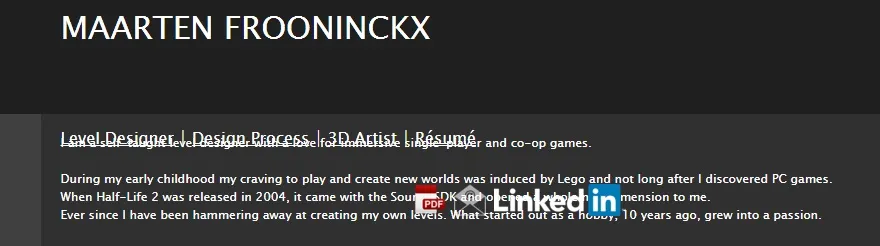
    In the particular case of your current portfolio, it would be slight touches such as renaming 3D Artist to something more 'humble' maybe, that shows that you don't necessarily consider yourself a full fledged 3d artist but have dabbed into that field and gain some very valid experience out of it; or increasing the font size of LD page links and decreasing the one for extra activities, or really fleshing out the LD page with lots of content and info so it's clear that this is your primary skillset, etc. In any case, I think you should do a new thread to get feedback on your portfolio in general, as I think there's some simple but efficient things you can do to make it a bit more 'professional-like' (fixing a few things like overlapping text (happens to me on chrome, see picture attached), filling up your process page or getting rid of it so it doesn't seem WIP, and adding a bit more descriptions/detail of your LD projects for instance)

    Extra note on portfolios though: from my experience, I cared a lot about how I would lay out my portfolio when I was looking for a job, but when I look at a candidate's portfolio, I rarely really pay attention to the layout of it or its aspect and go fishing for the content. I often only have a few minutes to dedicate to an application before I go: yes, let's do an phone interview or no, we have better candidates down the pipe or this one is just not what we're looking for. So portfolios in the end (again, in my experience) are really a case of 'I will only care about the aspect/layout if it really sucks'. I would prefer a Word document with pictures and descriptions in it that really manage to convey the candidate's strong points, experience (pro or not), specific skillset (MP, SP, MMO, Mobile, ...) etc. than a fancy portfolio with only nice pictures and nothing for me to dig my teeth in.

    Anyway, it's always a bit weird to advertize stuff like that because it can just lead to you being disappointed/or us put in an awkward position, but in any case feel free to apply as an LD at CIG Frankfurt if Star Citizen would interest you, we don't have a junior LD position open at the moment but in general we consider all applicants and try to dig deeper than what's on the resume to find potential diamonds in the rough, so if you're confident about your LD skills but have trouble getting employers to even give you a chance to convince them of your abilities, it MIGHT be different here (no promises of course, I don't make the calls, and I can be fairly ruthless during interviews). And if it only goes as far as a skype interview, that's always good experience to take, might give you the edge on a future interview.

Discord

The Mapcore Discord is our lively IRC channel of the 2000s reborn. Chat about level design, gaming, and more.

Latest Posts

  1. Tangerine

    Harry Poster
    July 18, 2026 at 11:10 AM
  2. Any of the old guard still around? D:

    Warby
    July 12, 2026 at 8:23 PM
  3. About our archived forums

    Thrik
    June 30, 2026 at 2:12 PM
  4. Mapcore Discord

    mason_fan123
    June 24, 2026 at 8:52 PM
  5. [CS2] Valley

    Serialmapper
    June 22, 2026 at 11:56 AM
  6. Free Music / SFX Resource - Over 2500 Tracks

    Eric Matyas
    June 18, 2026 at 12:32 PM
  7. Pango [WIP]

    Elowen
    June 11, 2026 at 10:13 AM
  8. [CS2] Dvina

    Jeremy Rivera
    June 11, 2026 at 10:03 AM
  9. Bridges 2.0 by NEXSIDE, MAP SHOWCASE. ( Steam Workshop )

    MrTrane18
    June 1, 2026 at 7:46 PM
  10. Classic Maps Reborn For CS2

    SillySpaceCat
    May 31, 2026 at 10:33 PM
  1. Privacy Policy
  2. Contact
Powered by WoltLab Suite™